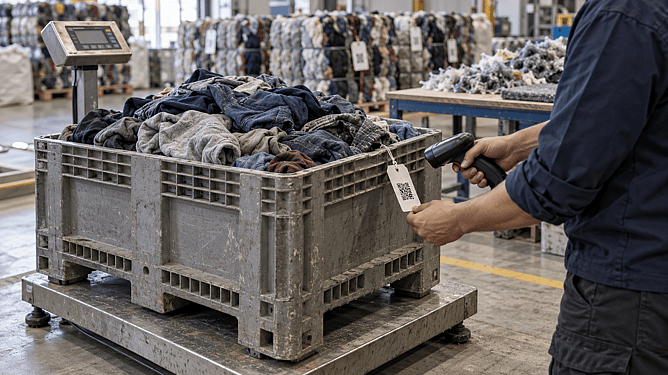
A digital product passport can tell us what a textile is made of—but who can prove where that material goes next?
Europe is building the paperwork for a circular economy. Under the EU’s Digital Product Passport, textile products sold there will carry a scannable digital record of what they’re made of, where they came from and how they can be dealt with at the end of their life.
The European Commission plans to adopt the textile rules in late 2027. Each set of passport rules can only take effect at least 18 months after it’s adopted. Separately, since July 2026, large companies there have been banned from destroying unsold clothing and footwear. It’s a big step.
But as an engineer, I see a gap. A passport tells you what a product claims to be. On its own, it doesn’t prove what happened to the material after the product was thrown away.
That’s the half of the story we work on at ēkot. When a jacket is collected, sorted, shredded and turned into an input for something new, every step either keeps the chain of evidence intact or breaks it. If a bale labelled “polyester” is actually a poly-cotton blend with elastane in it, no amount of paperwork upstream will fix that downstream.
In engineering, we don’t accept “trust me”. We ask for test certificates, batch records and a chain of custody. Recovered materials deserve the same rigour, and buyers should expect it. That’s the thinking behind ēkotrace. It doesn’t try to record everything. It records what physically moves: real kilograms, at real handover points, from collection to finished input. If it didn’t move, it doesn’t go in the record. That discipline is what turns a sustainability claim into something an auditor, specifier or procurement team can rely on.
New Zealand isn’t bound by EU rules, but our exporters will face the same questions sooner or later. The organisations that can answer with evidence, not estimates, will be the ones others choose to trade with. Passports describe products. Proof follows the material.
A circular economy needs both, and here in Aotearoa the second is the one we’re missing. Which raises the next question: once we can prove where a material has been, where will those materials come from, and who is ready to buy them?
#CircularEconomy #Traceability #DigitalProductPassport #TextileWaste #SustainableProcurement #SupplyChainSustainability #CivilEngineering #Aotearoa #NewZealand