In Aotearoa New Zealand, we are fortunate to have an incredible, close-knit ecosystem of circular economy pioneers. From local op-shops sorting through tonnes of daily donations to recycling partners who keep waste out of landfills, the commitment to doing good is undeniable.
But as we work to transition these diverted waste streams into high-spec, mainstream industries like construction and infrastructure, we face a shared technical challenge:
How do we verify the physical journey of a recycled material in a way that the market instantly trusts?
Currently, the global industry relies almost entirely on paper-based chains of custody, PDFs, and transaction receipts. But as regulations tighten, relying on administrative paperwork alone leaves well-meaning local brands and suppliers exposed to compliance risks. At ēkot, we believe the solution is not to police our local supply chains, but to empower them.
By building ēkotrace, we are creating a digital material-provenance platform designed to validate and protect the great work already happening across New Zealand.
Taking Product Stewardship Seriously: Our Cascade Approach.
For us, this transparency is the engine behind genuine product stewardship. We believe that true sustainability means taking collective responsibility for a product throughout its entire life cycle—from design to end-of-use. This isn't just a local trend; it is a global regulatory shift. For example, under the EU's Ecodesign for Sustainable Products Regulation (ESPR), a landmark ban on the destruction of unsold apparel, accessories, and footwear came into force for large companies on 19 July 2026. Under these strict rules, "destruction" includes sending usable, unsold garments directly to landfills, energy recovery, or even premature recycling without first attempting to reuse or repurpose them.
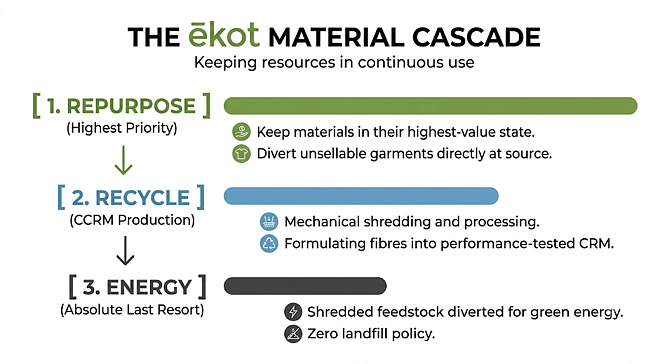
This aligns perfectly with our cradle-to-cradle mantra and our strict cascade approach:
Repurpose: Keeping the material in its highest-value state for as long as possible.
Recycle: Transforming the physical fibres into new technical inputs.
Energy Recovery: Using recovered materials as feedstock for green energy (such as incineration) is our absolute last resort.
While our immediate focus is on tackling New Zealand's massive textile waste problem, the beauty of the ēkotrace architecture lies in its inherent flexibility. As international frameworks like the Packaging and Packaging Waste Regulation (PPWR) begin demanding similar digital labelling and material-tracking standards for packaging, our platform is already set up to scale. The same robust traceability pathways we use for textiles can easily be applied to other complex waste streams in the future.
The Chemistry of Trust: Solving the Molecular Blindspot.
To understand why we need better tools, we have to look at the physical reality of the materials we are trying to rescue. Let's take recycled polyester (rPET) as an example. When a brand sources fabric containing rPET, it is given a paper certificate verifying its recycled origin. They trust it, and the supplier issued it in good faith. However, the molecular reality is that recycled polyester and virgin polyester are chemically identical.
Standard laboratory testing cannot distinguish whether those molecules came from a fresh barrel of oil or were mechanically recycled from a plastic beverage bottle. Because they are identical under conventional testing, we are left relying entirely on paper trails. If there is an administrative error or a gap anywhere in a multi-tiered supply chain, the local brand's reputation is on the line. To protect our local industry, we need a way to back up our digital and paper records with physical, scientific evidence.
For example, when PET beverage bottles are manufactured, producers typically add a trace compound called isophthalic acid (IPA) to improve the bottle's clarity and strength. When those bottles are recycled into fibres, that chemical signature remains trapped in the polymer. By utilising targeted laboratory testing to detect these specific markers, we can physically confirm whether a synthetic fibre actually originated from recycled bottle stock.
Physical testing is a vital auditing tool, but it doesn't scale on its own. The real breakthrough happens when we use these scientific tests to validate and anchor our digital ledger, ēkotrace.
Formulating Certified Circular Raw Materials (CCRM).
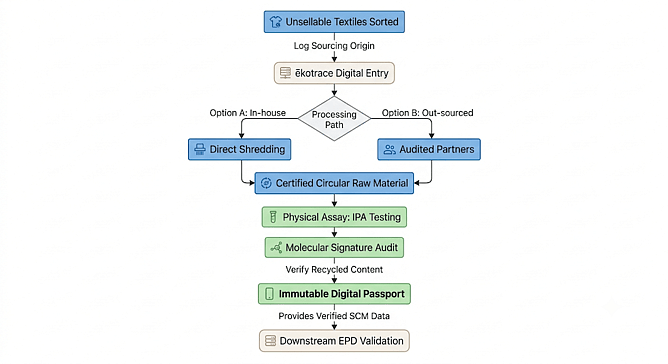
This is where the distinction between traditional recycling and certified circular sourcing becomes critical. Local recyclers are excellent at collecting and sorting. In some cases, we collaborate with these specialist partners to shred and process these feedstocks. In other cases, we handle the shredding and processing directly at ēkot.
By managing this transformation—whether in-house or through audited partners—we formulate these raw inputs into standardised, performance-tested Certified Circular Raw Materials (CCRM).
The ēkotrace platform integrates directly into this journey to capture data at every transition point:
Sourcing Integrity: Unsellable textiles are identified and logged at the collection level using simple digital tools.
Chain of Custody: As materials move through the sorting, shredding, and processing phases, every handover is logged.
Validation and Certification: We link the raw material's physical properties, performance data, and scientific validation tests directly to its digital passport.
This ensures that when an industry buyer sources CCRM, they are getting a certified, fully traceable material with an audit-ready digital history.
Supporting the EPD Journey.
This level of robust, defensible traceability is fast becoming a baseline requirement for doing business on the world stage. We are currently collaborating with the University of Waikato on an intensive R&D programme to test and validate the performance of recovered textile fibre in infrastructure and construction applications.
Once this R&D phase is complete, our goal is to secure independent Environmental Product Declarations (EPDs) for our own manufactured circular products. At the same time, we are actively working with our commercial supply chain partners to help them secure their own EPDs.
An EPD requires highly specific, verified life-cycle data for every single raw material input. With ēkotrace, we provide unassailable chain-of-custody data, so our own products and our partners' innovations can meet strict third-party audits, clear international regulatory hurdles, and back up carbon claims with certainty.
Building a Resilient Future, Together.
As CTO of ēkot, my mission is to build a technology platform that serves as a foundation of trust for Aotearoa's entire circular ecosystem. By bridging physical science with secure digital provenance, ēkotrace ensures that what is promised on paper is exactly what exists in reality.
With the platform live and running, we are continually improving our interactive, mobile-friendly interface based on real-world feedback from our partners, so tracking remains as seamless and intuitive as possible for brands, recyclers, and community stakeholders.
We aren't here to disrupt the pioneers who got us this far. We are here to give them the tools to prove to the world just how good they are. Let's work together to make Aotearoa's waste visible, valuable, and traceable.