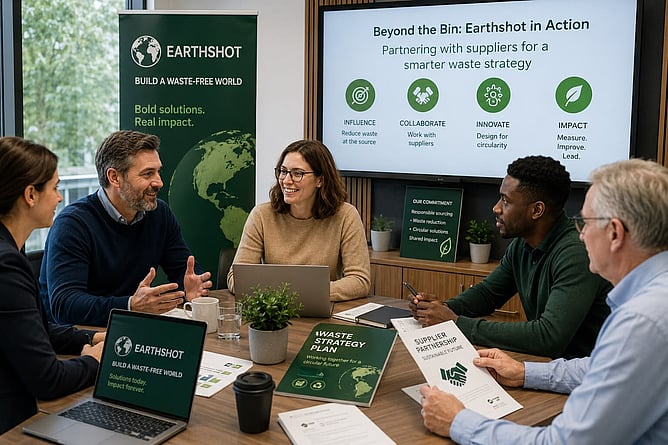
What if recycling were more than a responsibility—and became a catalyst for innovation?
For many businesses, recycling is treated as a necessary part of operations: sort the materials, empty the bins, meet compliance requirements, and move on. But that mindset only takes us so far. If we want to make meaningful progress toward a circular economy, we need to look beyond waste management and start seeing every material stream as an opportunity.
That is where the Earthshot mindset offers powerful inspiration. The Earthshot Prize challenges the world to repair the planet through bold, practical solutions. One of its five goals, “Build a Waste-Free World,” imagines a future where nothing goes to waste and the leftovers of one process become the raw materials of the next.
From Compliance to Circular Thinking
Traditional recycling often begins with a narrow question: “Are we doing the right thing with our waste?” Circular thinking asks a better one: “How do we design systems where waste is prevented, materials retain their value, and resources stay in use for longer?”
This shift matters because recycling is not just an environmental task. Done well, it can reduce costs, strengthen supply chains, improve sustainability reporting, and demonstrate leadership to customers, staff, and partners.
When we apply an Earthshot-inspired lens to recycling, three important changes happen:
From Compliance to Innovation: We stop asking "How do we follow the rules?" and start asking, "How do we eliminate the concept of waste entirely?"
From Cost to Value: We stop seeing recycling as an expense and start seeing it as a resource loop that fuels a circular economy.
From Effort to Impact: We set targets that don't just look good on a slide deck but actually move the needle for the environment.
The Materials of the Future Are Already in Your Business
Every day, businesses handle materials with real value: plastics, metals, paper, cardboard, organics, packaging, and production offcuts. The challenge is not simply to dispose of them correctly. The opportunity is to recover them cleanly, keep them useful, and return them to productive use wherever possible.
That starts with better visibility. Which materials are entering your site? Which ones are leaving? Are they separated in ways that preserve their quality? Do you know where they go after collection? These questions turn recycling from a back-of-house routine into a strategic business conversation.
Three Ways to Raise Your Recycling Ambition
A stronger recycling strategy does not have to begin with a complex transformation programme. It can start with three practical steps.
1. Protect material quality
Contamination is one of the biggest barriers to effective recovery. When paper, plastics, metals, food scraps, and general waste are mixed together, their value can be lost. Clear signage, simple bin systems, staff training, and regular checks help ensure materials remain suitable for reuse or recycling.
2. Influence what comes in
The best recycling strategy starts before waste is created. By working with suppliers, businesses can reduce unnecessary packaging, avoid hard-to-recycle materials, and choose inputs that are easier to recover. This upstream approach can prevent waste before it reaches the bin.
3. Track the journey
“Out of sight” can no longer mean “job done.” Businesses need confidence in where their materials go and how they are processed. Transparent reporting helps turn recycling claims into measurable outcomes and gives teams the information they need to keep improving.
The Earthshot Challenge for Your Business
To move from standard recycling to a more ambitious resource recovery strategy, ask your team:
· Are we separating materials in a way that protects their value?
· Are we working with suppliers to reduce waste before it enters our site?
· Do we know what happens to our materials after collection?
· Are our recycling results visible, measurable, and improving over time?
These questions are simple, but they are powerful. They move the conversation from compliance to leadership—and from waste disposal to resource stewardship.
From Good Enough to Worth Doing Well
Recycling will always involve practical details: bins, collections, sorting, contracts, audits, and reporting. But behind those details is a bigger question: what kind of future are we helping to build?
The Earthshot mindset reminds us that ambitious environmental action is not only possible—it is necessary. For businesses, that does not mean claiming to have all the answers. It means choosing to raise expectations, measure progress honestly, and keep looking for smarter ways to recover value from the materials we use.
Ready to move beyond the bin? Start by reviewing your material streams, identifying the biggest opportunities for improvement, and building a recycling strategy that turns waste into value.