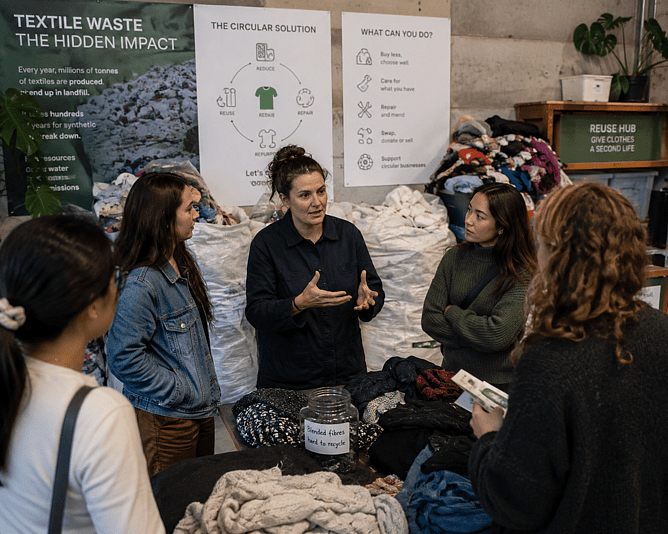
Can education help waste?
At the recent WasteMINZ Conference 2026 in Wellington, one thing became clear: New Zealand is beginning to sharpen its focus on priority waste streams. That is promising. It signals movement, intention, and acknowledgement that some materials are causing deeper environmental and economic strain than others.
But I left the conference carrying mixed feelings.
Not because the conversations lacked passion. In fact, the opposite. There were innovators, councils, policymakers, recyclers, educators, and businesses all trying to solve pieces of the same problem. Yet somewhere in between the discussions, one question kept surfacing in my mind:
How do we get everyone to understand that we all have a stake in this?
Because identifying priority waste streams is only the beginning.
Textile waste, for example, is still not considered a major priority stream in many conversations. And while that may sound discouraging to those working closely in the space, I actually came away feeling energised. Why? Because history has shown that innovation often begins exactly where awareness is lowest.
Sometimes change does not start with billion-dollar infrastructure.
Sometimes it starts with a simple shift in mindset.
A different way of designing.
A different way of consuming.
A different way of valuing materials before they become “waste.”
At ēkot, we often talk about circularity, but one thing became increasingly obvious during the conference: many people still equate circularity with recycling.
They are not the same.
Recycling is important, but it should be the last resort, not the first response.
Circularity is broader. It asks bigger questions:
Can this product be reused?
Can it be repaired?
Can it be repurposed?
Can materials be remanufactured into something new before being broken down completely?
Repurposing is circularity.
Remanufacturing is circularity.
Designing out waste from the beginning is circularity.
Recycling alone cannot carry the weight of our future systems.
And perhaps that is where the real opportunity lies for New Zealand.
Not just in creating better waste solutions, but in creating better understanding.
Because even the best policies will struggle if people do not see themselves connected to the outcome.
The more I reflected after the conference, the more one word kept returning:
Education.
Not education rooted in fear or guilt.
But education rooted in participation.
Helping people understand:
where materials go,
how systems work,
why waste has value,
and how individual decisions shape collective outcomes.
Education cannot be limited to schools.
It has to happen in businesses, households, local communities, supply chains, and industries.
And perhaps the better question is not:
“Where do we start?”
Maybe we already have.
Every conversation that challenges the status quo is a start.
Every business rethinking materials is a start.
Every person choosing repair over disposal is a start.
Every innovation that extends the life of a resource is a start.
The future of waste management may not simply depend on better technology.
It may depend on whether we can build a culture that understands waste differently altogether.
That is the shift worth investing in.